
Technology
How something that small does anything.
Bio-Energy-Stimulation works at the scale a body already uses — millionths of an amp, at frequencies chosen for the tissue being treated. What the name means, why the frequency matters, and what the points are for.
What is Bio-Energy-Stimulation?
The name is three words, and each one is doing a job.
- Bio
- It works with what a body already does, rather than introducing something to it. Nothing is injected and nothing is given.
- Energy
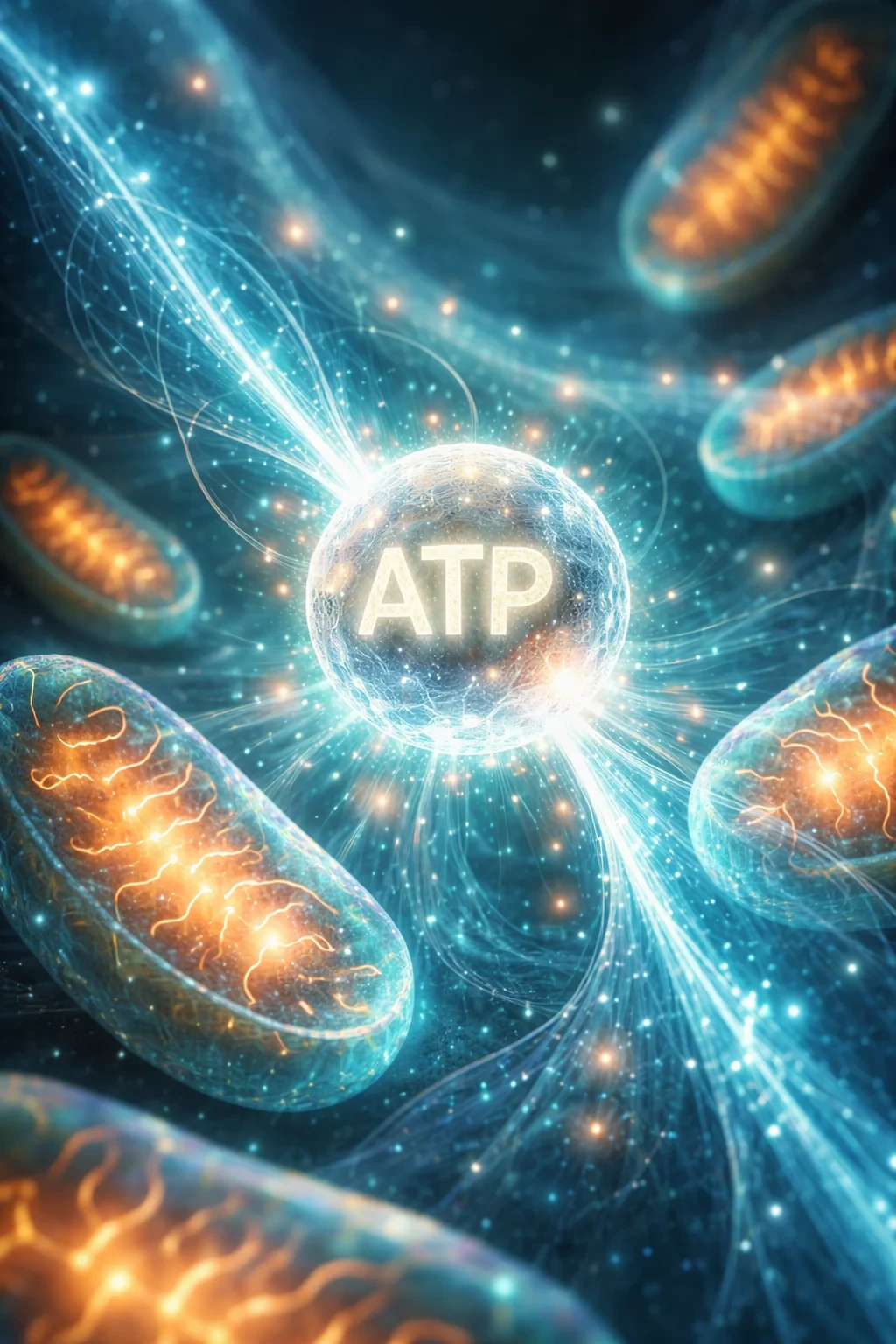
- The energy in question is ATP: what every cell in a body spends in order to do anything at all.
- Stimulation
- Here it means encouraging a process, not forcing a movement. Nothing twitches; the current is far too small to make a muscle contract. What it offers is closer to a reminder — how a tissue runs when it is running properly, at full power, doing its own work.
Those three words are also the shape of this page: what a body already does electrically, what ATP is and why it matters, and what a very small current at a chosen frequency is actually for.
Bodies already run on electricity
This is not a figure of speech. When a vet puts a horse on an ECG, they are reading the electrical signal that makes his heart beat. Nerves carry their messages as electrical impulses. Every cell in his body holds a small voltage across its outer wall, and that voltage is what decides what gets into the cell and what gets out again.
Electricity is not something foreign being introduced to a horse. It is one of the ways his body already runs itself.
Microcurrent works at that scale — the same order of size as the currents a body generates for itself. It is not strong enough to make a muscle contract, which is why a horse in the middle of a treatment usually does not react at all, or simply relaxes into it.
Nothing in a body happens without ATP
Food is not what a muscle spends. Food is the bank; ATP is the cash. Everything a body does has to be paid for in ATP, and the body makes it, spends it, and makes it again, continuously, all day.
Every stride costs ATP. So does every breath, every heartbeat, digesting a feed, growing a hoof, staying warm on a cold night, and every repair a body makes to itself after work.
A cell short of ATP is not broken. It is slow. It still does its job, but it does less of it and it takes longer. Multiply that across a whole horse coming back from a hard day, and you have a fair picture of what recovery actually is — millions of cells doing work they have to pay for.
What the research measured
In 1982, Cheng applied currents below 500 microamperes to rat skin and measured the change against untreated tissue:
- ATP production
- +500–800%
- Protein synthesis
- +70%
- Membrane transport
- +40%
Why does the frequency matter?
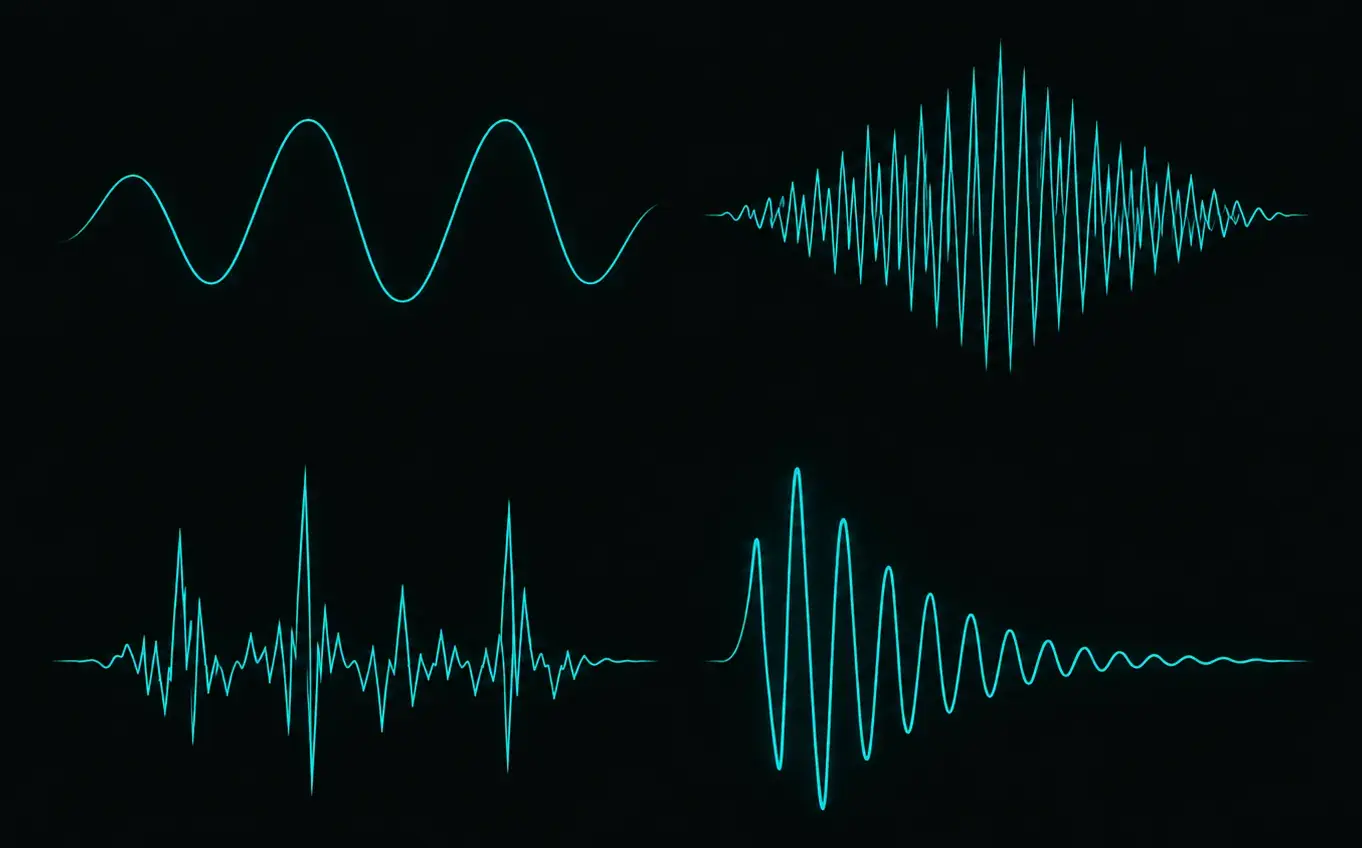
A frequency is just how often something repeats per second. A radio picks up one station because it is tuned to one frequency — same aerial, same signal, but turn the dial and you get nothing.
Tissues work in something like the same way. Different tissues, and different states of the same tissue, are associated with different frequencies. A tendon is not a hoof. A fresh strain is not one that has been there since spring.
That is why this is not a device with a dial you turn up. Each program carries the frequencies it was written for, and the reason there is a library of them rather than a single setting is that a body is not one thing.
Why does it matter where the pads go?
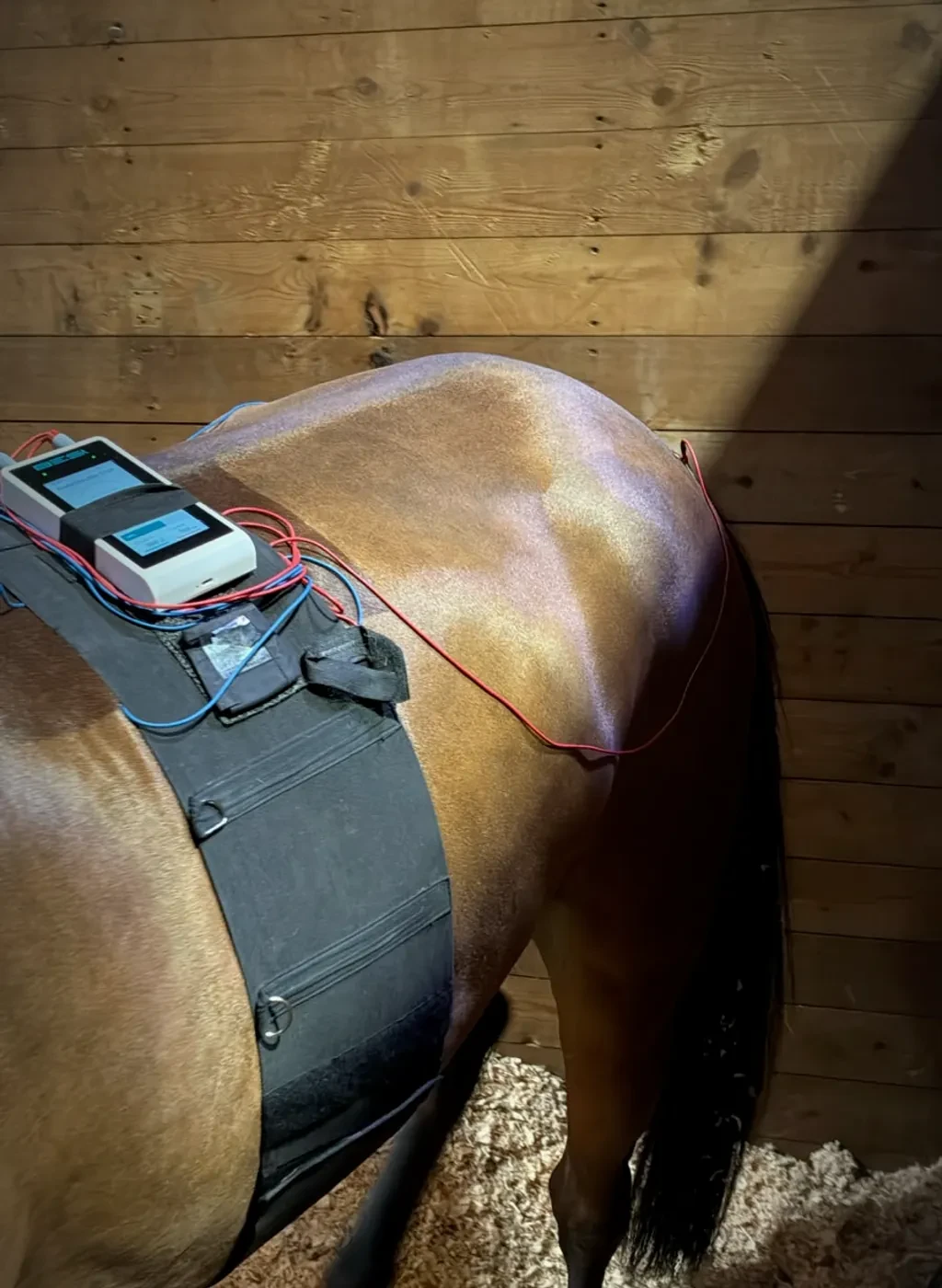
Because the current only goes where you put it. It travels between the pads, and whatever lies between them is what it passes through. Put both on the shoulder and it goes through the shoulder. Put them either side of a fetlock and it goes through the fetlock.
So placement is not a finishing detail. It is half the treatment — the right frequency arriving somewhere with no use for it is the same as nothing.
The points come from more than forty years of osteopathy, manual therapy and acupuncture, worked out again for equine anatomy. That is why every program has its own placement rather than a general area.
What is a treatment actually like?
About half an hour, in his own box, usually while he eats. Pads on a clean clipped coat where the manual shows for that program, one press, and nothing to adjust while it runs.
There is nothing sharp to feel — a faint tingle at most. Horses generally settle into it; some visibly relax, some lean into it. No anaesthesia, no heat, so no risk of burns. It is safe with metal implants, and it can be used alongside other therapy.
What a program is aimed at varies more than most people expect. Some are written for a tissue — a tendon, a muscle group, a hoof. Some are written for a system: circulation, drainage, digestion, breathing.
And some are not aimed at a tissue at all. A nervous system has two sides — the one that gets a horse ready to work, and the one that lets him eat, sleep and repair. There are programs for both: one to bring a horse up before work, another to let him come down afterwards.
Coverage differs too. Some programs treat the whole horse in one run. Others work one joint, or one limb, at a time, and the other side is a second treatment.
Why would something worked out on people apply to a horse?
Because a horse and a person are built from the same parts. ATP is ATP. A cell membrane holds its voltage the same way in both. A tendon is collagen under load whether it runs down a human forearm or a horse's cannon bone.
What differs is anatomy — where things sit, how big they are, how deep under the skin, what lies between the surface and the tissue you are aiming at.
The frequencies, the channel logic and the way a treatment is built up came from about fifty years of human clinical work. The equine programs were then re-reasoned for horse anatomy — not translated, re-reasoned, placement by placement.
One case, stated plainly
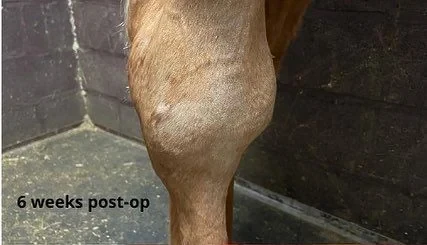
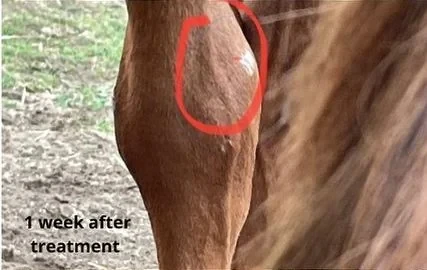
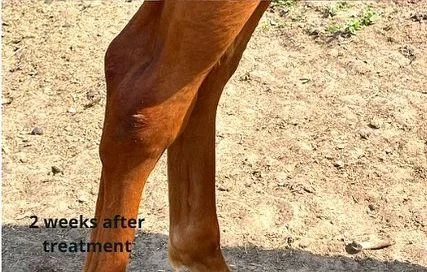
What was done, and what the photographs show. Nothing beyond that.
- Presented with
- Persistent swelling, six weeks after the operation.
- After
- Arthroscopic debridement of the lesser collateral in the hock joint.
- Treated
- Treated four times over one week with B-E-St specific microcurrent.
Where does the evidence come from?
From human and laboratory research, carried out over about fifty years. Three of the entries below are Nobel-recognised work on how cells store and spend energy, which is the reason this is not a fringe idea.
The literature
The most recent and the most directly relevant to a working athlete, human or otherwise:
- Stößlein & KuypersHuman research
Frequency-specific microcurrent after resistance training: improved self-reported recovery and mood, reduced training-related fatigue.
2022 · Maastricht University
- Peter D. MitchellUnderlying science
Chemiosmotic theory of biological energy transfer.
1978 · Nobel Prize in Chemistry
- Erwin Neher & Bert SakmannUnderlying science
Function of single ion channels in cells.
1991 · Nobel Prize in Physiology or Medicine
- Paul Boyer & John WalkerUnderlying science
Enzymatic mechanism underlying the synthesis of ATP.
1997 · Nobel Prize in Chemistry
- Ngok ChengLaboratory research
Effects of electric currents on ATP generation, protein synthesis and membrane transport in rat skin.
1982
- L. Y. W. BourguignonLaboratory research
Electric stimulation of protein and DNA synthesis, insulin binding, and intracellular calcium uptake in cultured cells.
1987–1989
- Carly and colleaguesHuman research
Electrical stimulation and the rate of wound healing.
1985 · Archives of Physical Medicine, vol. 66
- KennerlyHuman research
Amplitude and symmetry of alpha waves in the brain.
2005
- Björn NordenströmUnderlying science
Biologically Closed Electric Circuits.
1983
- Robert O. BeckerAmphibian research
The Body Electric.
1985
- Deborah PowellEquine practitioner text
Microcurrent for horses.
—
Bio-Energy-Stimulation is used across species: horses, dogs and cats.